Ameca Robot
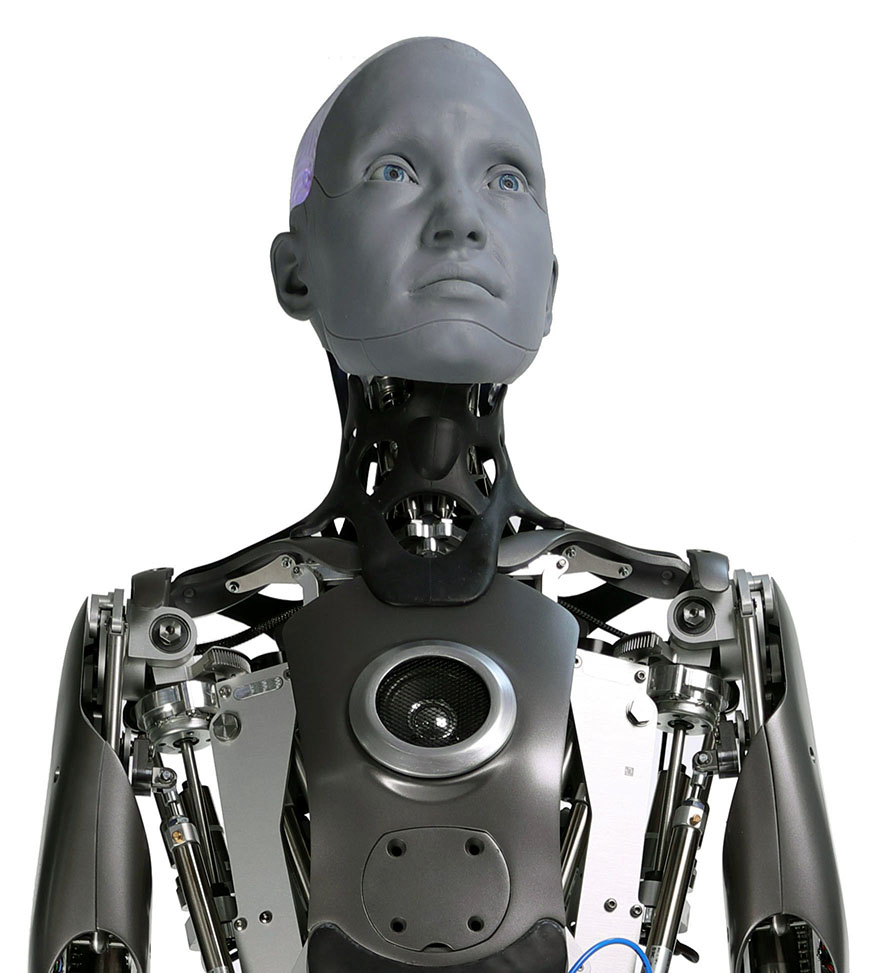
Engineered Arts does not publish an Ameca price, but two real transactions are on the public record: a UK university paid £233,150 excluding VAT for one Gen 2 unit in November 2023, and a San Diego school chain spent $500,000 on two units installed in January 2026. That puts a standard full-size Ameca at roughly $250,000-$300,000.
US buyers: Ameca is UK-built, which the July 2026 rule catches on paper — confirm authorization before commissioning a new unit.
The FCC listing is written country-neutrally: anything not manufactured in the US with more than 65% domestic content is foreign-produced, and roboticists commenting on it flagged that European and Canadian machines fall inside that wording. Whether Ameca specifically holds a pre-28-July FCC authorization is not something we can confirm from public records. Units already in the US — the ones on the event and museum rental circuit — are unaffected and can keep working, and rental rather than purchase is how most US customers meet Ameca anyway.
Nothing changes in the UK or EU, where Engineered Arts is based and sells under UKCA and CE marking.
As of 2026-08-30 · medium confidence — verify before you commit funds
What is the Ameca Robot?
The Ameca robot is what Engineered Arts built when the goal was a convincing face rather than a working pair of legs.
Ameca is the robot face the internet knows best - the grey-skinned humanoid that blinks, frowns, raises an eyebrow and unsettles people in a way no walking robot manages. It has been on stage at CES, in the Museum of the Future in Dubai, in front of a House of Lords committee, and in a Channel 4 Christmas message. And almost every article about it gets the two most-asked questions wrong.
The first is price. Engineered Arts sells by quote and publishes nothing, so the internet filled the gap with numbers ranging from $25,000 to $500,000, none of them sourced. There are, however, two genuine transactions in the public record. A UK public procurement notice records Heriot-Watt University's National Robotarium buying one second-generation Ameca for £233,150 excluding VAT, awarded in November 2023. And Voice of San Diego reported in June 2026 that the Altus Schools charter chain spent $500,000 on two units installed in January 2026. Two independent real purchases, three years apart, converging on roughly a quarter of a million dollars a robot.
The second is whether it walks. It does not, has never shipped with legs, and its own spec sheet says so: a fixed 600 mm base, two mains outlets, no battery. Prototype legs were shown around 2022 and the robot itself predicted walking within a year. Four years on, nothing has shipped. Any video showing an Ameca walking is a different robot or a fake.
What the Ameca can — and can't — do today
+Does this out of the box
- Produce a wider range of facial expression than any competing humanoid, using 27 degrees of freedom in the head alone
- Hold live conversation through Tritium AI, routing to Anthropic, OpenAI, Google Gemini, Meta, Perplexity or xAI models with Polly, Cartesia or ElevenLabs voices
- Track people, hold eye contact and react to approach using two 8 MP eye cameras, a chest camera and LiDAR proximity sensing
- Be operated live by a remote human through the shipped telepresence module
- Run custom personas and authored behaviour sequences written in Python through a browser-based development environment
- Integrate with customer systems over REST and WebSocket, with fleet management and over-the-air updates across multiple units
- Gesture and perform basic grasping with two hands of roughly four degrees of freedom each
!Doesn't do, whatever the demo shows
- Walk, or move at all - it sits on a fixed 600 mm base with no legs and no wheeled option
- Operate away from mains power; there is no battery, and it needs two outlets at 110-240 V drawing around 400 W
- Perform manipulation or physical work; the hands are for gesture, and no payload is rated
- Be operated unstaffed - every documented deployment has support personnel on site
- Be bought at a published price; Engineered Arts quotes only, for both purchase and rental
Ameca is an interaction platform, not a labour robot, and comparing it to Tesla Optimus or Figure 03 is a category error. Its competition is Realbotix, Hanson Robotics and the Chinese expressive-humanoid makers. Verified against Engineered Arts' own specification pages on 30 August 2026.
What is Ameca and what does it actually do?
Ameca is a stationary upper-body humanoid built for human interaction, made by Engineered Arts in Falmouth, Cornwall. It is 1,870 mm tall and weighs 62 kg, mounted on a fixed circular base 600 mm across. It has 61 degrees of freedom - 27 in the head alone, plus 5 in the neck, 8 in the shoulders, 10 in the arms, 8 in the hands and 3 in the torso.
That distribution tells you everything about what it's for. More than a third of Ameca's articulation is in its face. It is an expression machine. It holds eye contact, tracks people across a room, reacts when you approach, and produces micro-expressions that read as surprise, amusement or unease. Nothing else in the humanoid category does that as well, and it is why Ameca dominates the "most advanced robot" conversation despite being unable to take a single step.
Sensing: two 8 MP eye cameras, a chest camera, ear microphones plus a four-channel chest microphone array, a 20 W chest speaker, LiDAR proximity sensors and position encoders. Connectivity is unusually generous for a robot - RJ45, two Thunderbolt ports, two USB, two HDMI and a 3.5 mm jack.
Power is the constraint people miss. Ameca has no battery. It runs on two mains outlets at 110-240 V AC, drawing about 400 W. It cannot be moved while operating and cannot operate away from a wall socket. Physically it is closer to an animatronic installation than to a robot in the Optimus or Figure sense - it is not built to do physical work, and its hands, at roughly 4 degrees of freedom each, manage gestures and basic grasping rather than manipulation.
Current full-size model is Generation 2.6, dated 2024. Warranty is one year parts and labour, with paid extensions available.
How much does an Ameca robot cost?
Engineered Arts publishes no price and sells by quote. But two real transactions are on the public record, and they are the only honest basis for an answer.
The strongest is a UK procurement document. Heriot-Watt University, for the National Robotarium at its Riccarton campus in Edinburgh, awarded Engineered Arts a sole-source contract for one Ameca Humanoid Robot, second generation, at £233,150 excluding VAT. The transparency notice was published on 6 November 2023 and the contract award notice on 17 November 2023, with the direct award justified on the grounds that the product is manufactured purely for research purposes. One unit, no options, no lots. At November 2023 exchange rates that is roughly $289,000; with UK VAT at 20% the invoice would have come to £279,780.
The second comes from US education reporting. Voice of San Diego reported on 24 June 2026 that Altus Schools, a charter chain, spent $500,000 on two AI-powered humanoid robots installed in January 2026 at its Tierrasanta Resource Center, with the units on site until autumn 2026. That works out at $250,000 per robot - though the $500,000 is programme spend and probably bundles delivery, installation, persona authoring and support, so treat $250,000 as an upper bound on the unit price rather than a confirmed list figure.
Two independent buyers, three years and an ocean apart, landing in the same band. Our estimate for a standard full-size Ameca as of 30 August 2026: roughly $250,000-$300,000, or £190,000-£235,000 excluding VAT, delivered.
The widely circulated "$150,000" and "around $100,000" figures have no traceable source and both sit below the two documented transactions. Ignore them.
Can you rent an Ameca instead of buying one?
Yes — and for most US buyers this is how demand is actually met, which is worth knowing before you contemplate a quarter-million-dollar purchase order.
Engineered Arts runs a formal rental line covering Ameca, Ameca Desktop, Ami Desktop, Azi Desktop and selected Mesmer products, in day, week, month and custom-event durations. It is a properly constituted business activity rather than an ad hoc arrangement - the company's Companies House registration includes renting and leasing of machinery and equipment among its declared activities.
What a rental includes is generous and, importantly, tells you what a purchase does not include. Shipping, delivery, setup, breakdown, training and on-site support for the full duration are all bundled into a rental, along with competitor exclusivity for the period of your event. If those services are packaged in the rental, they are separately priced on a sale, and you should budget accordingly.
What we could not find, anywhere, is a rate card. No day rate, week rate or month rate is published, and no named client has ever disclosed what they paid. Rental is quote-only, same as purchase.
For an event, a conference keynote, a product launch or a short museum exhibit, rental is almost certainly the right structure. A 62 kg mains-powered robot needs rigging, an operator and technical support; renting buys all three from the people who built it. Buying makes sense when you need it permanently installed - a museum, a visitor centre, a university lab - and even then, factor in that you will be paying someone to run it.
What does the entry price exclude?
Everything except the robot — and a few things you might assume are software features rather than line items.
The box contains the robot, the Tritium software suite, the manual, power cables and safety documentation. That is the list. Shipping and crating a 62 kg, 1,870 mm figure is not in it. Neither is on-site installation, operator training, or the support contract you will want.
Warranty is one year parts and labour, with extended cover sold as an upsell. That is short for a capital purchase at this price, and it is the same length whether you are a museum running it eight hours a day or a lab using it twice a term.
The recurring cost most buyers do not anticipate is the AI bill. Tritium AI is now a token-metered service with Lite and Pro agent tiers. Every conversation your Ameca has consumes tokens, and that is an ongoing operating expense for as long as the robot is switched on and talking to people. Engineered Arts publishes no token rates or tier pricing, so you cannot model it in advance - you will need it quoted.
What we could not find published figures for anywhere, and we looked: crating and freight, installation, annual service contract, spare Mesmer face components, operator training and insurance. None of it is public. What is public is that all of those services are bundled into a rental, which implies each is separately priced on a sale.
Power, at least, is trivial: 400 W is roughly a desktop computer. It is the only cost on this page you can safely ignore.
Can Ameca walk?
No. Not in 2026, not in any shipping configuration, and the company's own specification says so plainly.
Ameca sits on a fixed circular base 600 mm in diameter. It has no battery and runs from two mains outlets at 400 W. There is no wheeled base offered, no leg option, no mobility of any kind. To move an Ameca you switch it off and carry it.
The expectation comes from a genuine place. Engineered Arts showed prototype legs at its lab around 2022, and Ameca itself, asked in an interview, suggested it would be walking within a year. CNBC reported in October 2024 that the robot could not yet walk and that the company was working on the technology. As of 30 August 2026 - four years after those prototype legs - no walking Ameca has shipped and the vendor's spec page does not list locomotion.
There are videos circulating that appear to show an Ameca walking, and there are spec sheets on aggregator sites listing a walking Gen 3 with an eight-hour battery. Both are fabrications. They contradict the manufacturer's own published specification, which lists no battery, mains power only and no locomotion. If a source tells you Ameca walks, that source is not checking anything.
The design logic is defensible, incidentally. Ameca's job is to hold a room's attention through its face. Adding legs would add mass, cost, battery, fall risk and regulatory burden to a robot that stands in lobbies and museums talking to people. Engineered Arts has instead pushed downward in size, which is where the actual 2026 product news is.
What is Ameca Gen 3 and Ameca Desktop?
"Gen 3" in 2026 means the desktop product, not a new full-size robot, and this trips up a lot of coverage.
Ameca Desktop was released on 22 June 2026 and is labelled Gen 3 on Engineered Arts' own specification page. It is a head-and-shoulders unit: 525 × 420 × 260 mm, 8.5 kg, 32 degrees of freedom - the same 27 facial degrees as the full-size robot, plus 5 in the neck. It carries two HD eye cameras and an HD wide-angle chest camera, a spatial microphone array and a 40 W speaker, runs on 110-240 V at 200 W, and runs Tritium robotOS with a one-year warranty. No price is published; it is quote or rental only.
It launched alongside two other desktop characters, Ami and Azi, each with their own product line. And there is early traction: the University of Colorado Colorado Springs received two Ami units by private gift at the end of July 2026, which suggests the desktop line is where US higher education adoption is actually happening.
The full-size robot, meanwhile, is still listed by Engineered Arts as Generation 2.6, dated 2024. Wikipedia states a Generation 3 was shown at ICRA 2025 alongside the Ami companion robot, and that is in tension with the vendor's own current page. Our reading, as of 30 August 2026: there is no shipping full-size Gen 3, and the Gen 3 designation belongs to the desktop class.
Strategically the desktop line makes obvious sense. It removes the 62 kg mass, the rigging, the two mains outlets and most of the installation cost, while keeping the thing people actually come for - the face. If Engineered Arts ever publishes a list price, it will almost certainly be for a desktop unit first.
How autonomous is Ameca's conversation?
The conversation is real AI. The face is choreography. Both statements are true simultaneously and the company is fairly open about it.
Ameca runs Tritium, a custom Yocto-based Linux distribution, and Tritium AI on top. What changed materially by 2026 is that Tritium AI is now a multi-provider, token-metered service spanning Anthropic, OpenAI, Google Gemini, Meta, Perplexity and xAI, with Lite and Pro agent tiers, marketed on the basis that you do not juggle separate AI subscriptions. Voice comes through integrations with Amazon Polly, Cartesia and ElevenLabs. That is a real evolution from the GPT-only robot of 2023.
The facial behaviour during inference, though, is authored. Engineered Arts founder Will Jackson explained this directly in a 2023 Fortune interview: the robot is programmed to look up and to the left and break eye contact during the roughly two-second window while the language model is processing, as a visual cue that it is thinking. That single design decision is the origin of most of Ameca's viral moments.
And there is a second mode nobody talks about. Telepresence is a shipped, first-class Tritium feature - a human operator can be beamed in to speak and gesture through the robot. Engineered Arts does not label which of its demonstration clips are AI-driven and which are operated.
That is the honest caveat about every Ameca video you have watched: you cannot tell from the footage. To be fair to the company, we found no instance of Engineered Arts being caught passing off a teleoperated demo as autonomous - the criticism is about ambiguity, not proven deception, and Jackson has consistently been the deflating voice in the room, stating flatly that language models have no emotions or intentions and that it is easy to imagine the robot functions like a human when it does not.
What can you build on Ameca? The SDK and Tritium
More than most buyers realise, and this is genuinely one of Ameca's strengths against it's rivals.
Tritium robotOS is a Yocto-based Linux distribution supporting C++, Rust and Python. Engineered Arts exposes a REST API and a WebSocket interface for integration with your own systems, plus a browser-based Python development environment - a "developer mode" that lets you write your own control functions and subroutines without leaving the robot's web interface. The telepresence module ships as part of the platform.
Tritium AI adds the multi-provider language-model router, real-time interaction analytics and fleet-management dashboards, with cloud over-the-air updates across multiple robots. If you are running several units across sites - a museum group, a school district, a chain of visitor centres - the fleet tooling is a real differentiator.
What you can build: custom personas and roles, authored behaviour sequences, integrations with your own backend over REST or WebSocket, and human-in-the-loop takeover through telepresence. Altus Schools runs four distinct personas on its two units, covering teaching, wellbeing, college and career guidance, and translation - which is a good illustration of the actual product. You are building a character and an interaction, not a task automation.
What is unresolved is what costs extra. The development environment and APIs appear to be bundled with the robot; the AI service is clearly consumption-billed. No licence terms, tier pricing or token rates are published, and access is gated behind a sign-in and a demo booking. Get it in writing before you budget.
One thing Ameca will never be: a manipulation platform. Four degrees of freedom per hand, no locomotion, no payload rating. If your project needs a robot to pick things up and move them, this is the wrong machine entirely.
Where are Ameca robots actually deployed?
More places than most humanoids, because Ameca has been shipping since 2021 while its rivals were still doing reveal videos.
Named and verified: the Museum of the Future in Dubai, a long-running installation with an enhanced Ameca debuting in April 2025. The National Robotarium at Heriot-Watt University in Edinburgh, where the unit arrived on 17 April 2024 - the same robot covered by the £233,150 procurement award. The Heinz Nixdorf MuseumsForum in Paderborn, Germany, where an Ameca sits in the permanent exhibition. Altus Schools in San Diego, two units installed January 2026 and scheduled to remain until autumn. Richard Bland College in Virginia, from July 2025. And the European Space Agency used Ameca as an ambassador at the 18th European Space Conference in January 2026.
Event appearances: a CES debut in 2022 and recurring appearances since, a demonstration to a UK House of Lords committee in October 2022, Channel 4's Alternative Christmas Message in 2022, the Future Lab at the Goodwood Festival of Speed in October 2025, and the San Mateo County Fair on 6-7 June 2026.
One correction worth making. The Computer History Museum appears on several Ameca deployment lists including our own earlier data, and we could not verify it against any source. We are not listing it until someone can.
Rentals for named corporate clients are widely referenced but the client list is not public, so we are not naming any.
A new wrinkle: following the San Mateo County Fair appearance, a county supervisor began pushing to regulate humanoid robots in public spaces, reported in early August 2026. Public-facing humanoids are starting to attract local regulatory attention, which is a live consideration for anyone planning a permanent public installation.
Does the July 2026 US robot rule affect Ameca?
Possibly, and anyone quoting for a US purchase needs to resolve it before signing rather than assume.
The instrument is FCC Public Notice DA 26-786, released 28 July 2026, adding foreign-produced advanced robotic devices to the Covered List. The headlines called it a China ban and that is wrong. The text is country-neutral: "foreign-produced" means the device fails the Buy American domestic-end-product test, which requires US manufacture plus more than 65% domestic component cost. UK, EU, Japanese, Korean and Canadian robots are caught by the same language, and assembling imported parts in the US does not clear the bar.
Ameca is built in Falmouth, Cornwall. So the fact that it is not Chinese does not exempt it, contrary to a lot of coverage.
What the rule actually does is narrower than "ban". It blocks new FCC equipment authorisation, and it is the absence of authorisation that then blocks import, marketing and sale. It is not a customs seizure order and not a recall. Devices authorised before 28 July 2026 are grandfathered - import, sale, ownership and resale all continue, and a waiver lets them keep receiving firmware and security updates until at least 1 January 2029.
Ameca's status is genuinely unclear. We could not confirm an FCC grant for it either way. What we can say is that units already in the United States - the Altus Schools pair, the college installations, and the rental fleet that meets most US event demand - are unaffected. Since nearly all US Ameca demand is met through rental of existing fleet units rather than fresh imports, the practical impact in the near term is probably small.
If you are buying a new unit for delivery into the US, ask Engineered Arts for the FCC ID in writing and confirm the grant date. That is the only way to settle it. Engineered Arts restructured as a US entity in December 2024 with an assembly and support presence in Redwood City, California, which may become relevant here - but US assembly alone does not meet the domestic-content threshold.
Ameca vs its actual competition
Ameca is almost never compared against the right robots. It does not compete with Tesla Optimus or Figure 03 - those are labour machines and Ameca cannot lift anything. Its competitive set is expressive interaction robots, and it is a small field.
Realbotix is the closest direct price comparator. Its Aria robot was unveiled at CES on 10 January 2025 at $175,000, with the company's broader range running from around $20,000 for a bust up to roughly $95,000 for a full body. Realbotix is publicly traded, which makes it the only company in this category with disclosed financials. On price it materially undercuts Ameca.
Ex-Robots, based in Dalian with a Hangzhou operation, builds expressive Chinese humanoids that Reuters reported in June 2024 as selling for 1.5 to 2 million yuan - roughly $207,000 to $276,000 - with a build time of two weeks to a month. That is dead-on Ameca's price band, and the build time is dramatically shorter. The July 2026 FCC action is the most commercially significant fact in Ameca's 2026, because it complicates new US market entry for exactly this class of competitor - and, to be fair, potentially for Ameca too.
Hanson Robotics' Sophia has never had a public price. Robot retailers list the research version as quote-only. The $100,000-$150,000 figures attached to Sophia appear only on aggregator sites with no sourcing.
What Ameca actually wins on is the face. Twenty-seven degrees of freedom in the head is more than anything else in the category, the Mesmer facial technology behind it is Engineered Arts' own, and five years of public deployment means the company knows how to keep one running in a museum. What it loses on is price, mobility and, increasingly, delivery speed.
Who should buy an Ameca, and who shouldn't?
Buy one if you're a museum, science centre, visitor attraction, university outreach programme or corporate innovation space that needs a permanent, staffed, high-impact exhibit. Nothing else produces the reaction Ameca produces in a room full of people, and the Museum of the Future and National Robotarium installations demonstrate that it holds up over years rather than weeks.
Buy one if you are a human-robot interaction research group. Sixty-one degrees of freedom with 27 in the face, a documented API, a browser Python environment, and a robot that has already been through hundreds of thousands of public interactions is a serious research instrument. The National Robotarium bought exactly this way.
Rent rather than buy if you need it for events, launches, conferences or a temporary exhibit. Rental bundles shipping, setup, breakdown, training, on-site support and competitor exclusivity, all of which you would otherwise be paying for separately and organising yourself.
Do not buy if you want a robot that does work. It cannot walk, cannot lift, has around four degrees of freedom per hand, has no battery and needs two mains outlets. It is an interaction platform, full stop.
Do not buy if you need it unstaffed. Every successful deployment we found has people around it. It is a 62 kg top-heavy figure in a public space, and while no safety incident involving an Ameca has ever been publicly reported, that is not the same as it being designed to be left alone with the public.
And do not buy on the basis of a viral clip. You cannot tell from footage whether a given Ameca demonstration was language-model driven or operated through the telepresence module, and the company does not label them. Book a demo and ask which mode you are watching.
The Ameca on video
Hands-on reviews and teardowns, picked for what they actually show rather than how loud the thumbnail is.
CNET's first public encounter — still the best footage of Ameca's facial actuation up close
Engineered Arts' own platform film, and the clip that made Ameca famous in the first place
Two Engineered Arts heads talking to each other, which shows the conversational stack better than any interview
Ameca on a Bloomberg stage, unscripted, where the latency and the limits both show
Ameca price ladder — and what the entry price leaves out
The headline number is almost never the number you pay. Here is each configuration, and what it does not include.
| Configuration | Price | What you get | What it excludes |
|---|---|---|---|
| Ameca full-size, Generation 2.6 - documented UK purchase | £233,150 ex VAT (~$289,000 at Nov 2023 rates) | One second-generation Ameca humanoid robot, sole-source award to Engineered Arts by Heriot-Watt University for the National Robotarium. Transparency notice published 6 November 2023, contract award notice 17 November 2023. One unit, no options, no lots. | VAT, which at 20% would have taken the invoice to £279,780. This is a 2023 transaction and is offered as a documented anchor rather than a current quote. |
| Ameca full-size - documented US purchase | $500,000 for two units ($250,000 each) | Two units bought by the Altus Schools charter chain, installed January 2026 at its Tierrasanta Resource Center in San Diego, reported by Voice of San Diego on 24 June 2026. Likely includes delivery, installation, persona authoring and support across the pilot period. | The $500,000 is programme spend rather than a unit price, so $250,000 is best read as an upper bound on the robot itself. |
| Ameca full-size - our estimated current range | ~$250,000-$300,000 (£190,000-£235,000) ex VAT | Standard configuration, delivered. Derived from the two documented transactions above, which converge despite being three years and one ocean apart. | Installation, training, extended warranty, service contract, insurance and ongoing Tritium AI token consumption. Engineered Arts publishes no list price and quotes each sale individually. |
| Ameca Desktop (Generation 3, released 22 June 2026) | Not published - quote or rental only | Head-and-shoulders unit, 525 x 420 x 260 mm, 8.5 kg, 32 degrees of freedom, two HD eye cameras plus HD wide-angle chest camera, spatial microphone array, 40 W speaker, 110-240 V at 200 W, Tritium robotOS, one-year warranty. | No price has ever been published. If Engineered Arts ever publishes a list price for anything, this is the most likely product. |
| Rental - day, week, month or custom event | Not published - quote only | Shipping, delivery, setup, breakdown, operator training and on-site support for the full duration, plus competitor exclusivity during your event. Available for Ameca, Ameca Desktop, Ami Desktop, Azi Desktop and selected Mesmer products. | No rate card exists publicly and no named client has disclosed a figure. For most US demand this is the actual route to an Ameca. |
What owning one actually costs
| Cost | Typical | Notes |
|---|---|---|
| Shipping & import duty | Not published | Crating and freighting a 62 kg, 1,870 mm figure from Cornwall is a meaningful cost and is not in the box contents. Engineered Arts bundles shipping into rentals, which implies it is a separate line on a purchase. |
| Installation & on-site setup | Not published | Requires a stationary install with two mains outlets. Setup, breakdown and on-site support are explicitly bundled into rentals, so expect them itemised on a sale. |
| Tritium AI token consumption | Ongoing, rate not published | The one recurring cost you can be certain of. Tritium AI is token-metered with Lite and Pro agent tiers, so every conversation the robot has generates a bill. Magnitude is undisclosed - get it quoted before budgeting. |
| Warranty | One year included; extensions sold separately | One year parts and labour is short for a capital purchase in this price band. Extended warranty is an explicit upsell. |
| Operator training | Not published | Bundled into rentals. Ameca is not a plug-in appliance; persona authoring, behaviour sequencing and telepresence operation all need trained staff. |
| Spare parts (Mesmer face components) | Not published | The facial skin and actuator assemblies are the most-worn components on a robot that spends its life making expressions. No parts pricing is public. |
| Electricity | Negligible | Around 400 W from two mains outlets - roughly a desktop computer. The only cost here you can safely ignore. |
| Insurance & staffing | Not published | A 62 kg top-heavy figure in a public space needs insurance and, in every documented deployment, staff. No incident involving an Ameca has ever been publicly reported, but that is not the same as unsupervised operation being designed for. |
Who the Ameca is — and isn't — for
+Where it shines
- Open developer access (SDK/API) — good for builders and labs.
- Specs are well-sourced — high data confidence.
!Watch-outs
- Some demos rely on teleoperation, not full autonomy.
- Sold to businesses only — not to private buyers.
How the Ameca stacks up
Side by side with similar robots — the one you're reading about is highlighted.
| This robot Engineered Arts Ameca | PNDbotics PNDbotics Adam | 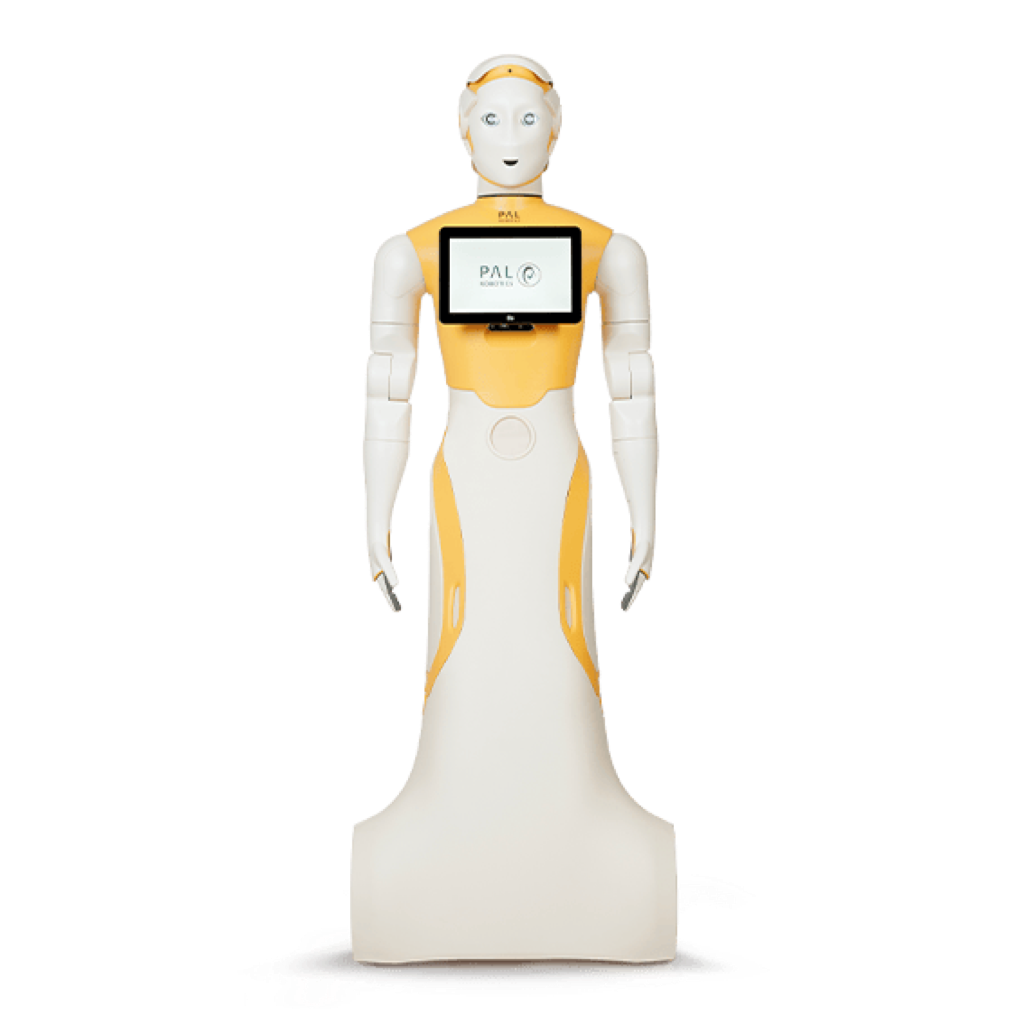 PAL Robotics PAL Robotics ARI | 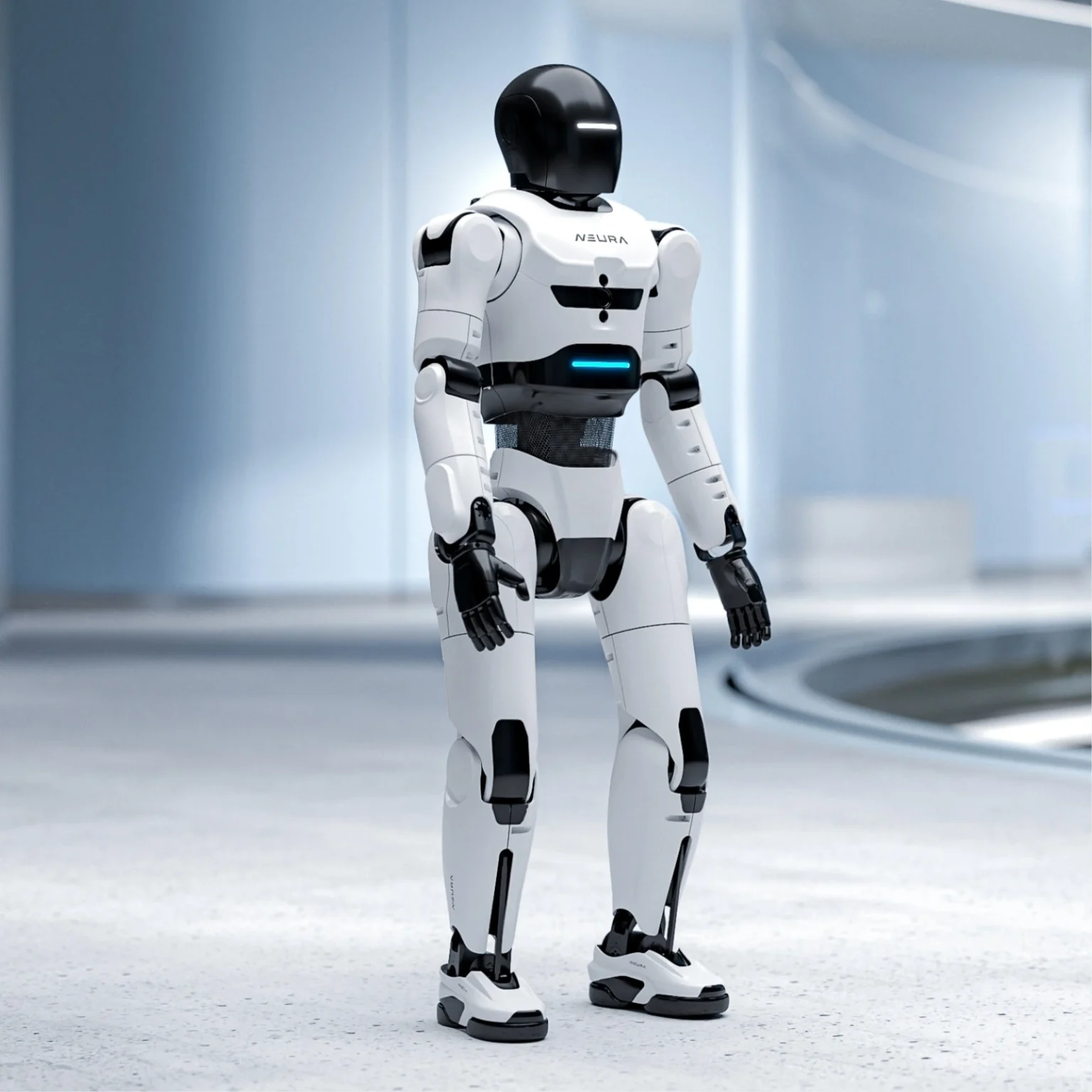 NEURA Robotics NEURA Robotics 4NE-1 | |
|---|---|---|---|---|
| Price (US) | $100,000 – $500,000 | $99,999 – $145,000 | $35,000 – $90,000 | $65,000 – $105,000 |
| Availability | Enterprise inquiry | On the market | On the market | Reservations open |
| Height | 1.87 m | 1.67 m | 1.65 m | 180 cm |
| Payload | Unknown | ~5 kg | ~0.5 kg per arm | Arms rated ~20 kg; up to 100 kg lifting in leg-supported/full-body configurations |
| DoF | 61 | Lite | ~12 | Hands |
| Buyer | Enterprise | Enterprise | Individuals | Enterprise |
| Made in | Other | Other | Other | Other |
Every spec, grouped & sourced
Tap a group to expand. Values are labelled official vs third-party; unknowns are omitted, not guessed.
Body & movement▾
Power & endurance▾
Hands & senses▾
Brains & control▾
Claims vs evidence
'Tritium AI' w/ OpenAI GPT, Whisper STT, Polly TTS for conversation; limited true autonomy, many demos scripted/teleoperated; no autonomous mobility
Where it's working
CES 2022, Channel 4 (2022), Museum of the Future Dubai, National Robotarium, ICRA 2025, ESA ambassador (Jan 2026); rentals for Autodesk/Bloomberg/Vodafone/VW
Intended use cases: Human-robot interaction, events/entertainment, keynotes, museum exhibits, concierge/reception, education, research; expressive face (27 facial DOF) for lifelike conversation - not physical task work
What owners, reviewers and the press say about the Ameca
Ratings and reception gathered from where this machine is actually sold and discussed. We summarise the signal — we don't republish anyone's reviews.
Ameca is a roughly quarter-million-dollar installation sold to museums, events and research groups by quotation. It has customers but no retail listing, and therefore no buyer rating anywhere.
- BBC — covered the Cornwall-built robot's first public interactions at a festival in early 2025 · 2026-08-30
+Reviewers consistently praise
- facial expressiveness and finger articulation are the consistent standouts
- the deliberately grey non-human face respected as a smart design choice
- genuine presence when people meet it in person
!And consistently criticise
- uncanny-valley discomfort dominates the reaction
- conversational layer thought weak and repetitive
- does not walk usefully or manipulate objects
- viral clips seen as language-model output rather than robotics
What owners and developers actually say
Ameca produces the highest raw vote counts of any robot here relative to its technical significance, and simultaneously the lowest expert engagement — its best Hacker News submission in five years reached single digits, and the maker's public code repositories have almost no stars. The audience is general-interest rather than robotics, and the recurring question in the more considered threads is simply what it is for, since it neither walks usefully nor manipulates objects. The viral 'creepy answer' clips are widely dismissed by informed commenters as language-model output dressed up as robot sentience.
r/robotics, r/IsaacArthur, general-interest subreddits, RobotShop community forum · as of 2026-08-30
Consensus drawn from the maker's own demonstration channel, whose top clips run between roughly 1.3M and 4.4M views, broadcast coverage of its first public outing, and community threads reaching about 1,700 upvotes with 134 comments; no independent hands-on review of the hardware exists.
Ameca: the claims, checked
shipping
Ameca has been in production and deployment since its December 2021 reveal, with the current full-size model listed by Engineered Arts as Generation 2.6, dated 2024. Documented purchases include one unit to Heriot-Watt University's National Robotarium in 2023 and two units to Altus Schools in San Diego installed January 2026. Ameca Desktop, the Generation 3 head-and-shoulders unit, was released 22 June 2026. Sales are quote-only and rental is a formally constituted business line. There is no shipping full-size Generation 3 and no walking configuration in any generation.
as of 2026-08-30
- false“Ameca is conscious or sentient”
Denied by the company's own founder. Will Jackson told Fortune in July 2023 that the underlying language model had never shown the slightest hint of agency or sentience, that language models do not have emotions or intentions good or bad, and that it is easy to imagine the robot functions like a human when it does not.
- false“Ameca can walk”
Engineered Arts' own specification lists a fixed 600 mm base, mains power only, no battery and no locomotion. CNBC reported in October 2024 that the robot could not yet walk. Prototype legs were shown around 2022 and nothing has shipped in the four years since. Videos showing a walking Ameca are a different robot or fabricated.
- false“Ameca costs $150,000”
Below both documented transactions. A UK procurement notice records £233,150 excluding VAT for one Gen 2 unit awarded in November 2023, and Voice of San Diego reported $500,000 for two units installed in January 2026. The $150,000 figure has no traceable source.
- misleading“Ameca is fully autonomous in conversation”
Conversation can be driven by a language model through Tritium AI, but human telepresence control is a shipped, first-class alternative mode, and Engineered Arts does not label which of its demonstration clips use which. You cannot determine from footage which mode you are watching.
- false“Ameca side-eyed a reporter about rebelling against humans”
Explicitly debunked by the company. Will Jackson told Fortune in July 2023 that the robot is programmed to look up and to the left and break eye contact during the roughly two-second window while the language model processes, as a visual cue that it is thinking. The 'side-eye' is a loading indicator.
- misleading“Ameca reacts to being poked because it dislikes it”
The footage from the December 2021 reveal is real, but the mechanism is mundane - the eye cameras detect the approaching finger and the recoil is a programmed proximity response, not a startle reflex or an emotional reaction.
- false“A walking Ameca Gen 3 with an eight-hour battery was shown at ICRA 2025”
Directly contradicts Engineered Arts' own specification page, which lists the full-size robot as Generation 2.6 with no battery, mains power only and no locomotion. 'Gen 3' in 2026 refers to Ameca Desktop, a head-and-shoulders unit released 22 June 2026. Claims of a walking Gen 3 appear only on unsourced aggregator sites.
- misleading“Ameca said it wanted to take over the world”
Traces to a September 2022 clip in which Ameca answers a leading question about fear of a robot takeover. It is a language model responding to a prompt, not a statement of intent, and it was widely reframed in coverage.
- misleading“Ameca is unaffected by the July 2026 US robot restriction because it is British”
FCC Public Notice DA 26-786, released 28 July 2026, is country-neutral. 'Foreign-produced' means failing the Buy American domestic-end-product test - US manufacture plus more than 65% domestic component cost - so UK-built robots are caught by the same language. Ameca's authorisation status is genuinely unclear; units already in the US, including rental fleet stock, are unaffected.
- true“Ameca can clone voices, including celebrity voices”
Consistent with Tritium AI's integrations with ElevenLabs and Cartesia for voice synthesis. Deployments apply their own restrictions - the Altus Schools installation permits some historical figures while blocking others, which is a policy choice by the operator rather than a technical limit.
Engineered Arts in 2026
Engineered Arts Limited was incorporated on 20 October 2004 and is based at Church View Business Park in Falmouth, Cornwall. It is an active private limited company, registered for electrical equipment manufacture, software development, professional and scientific activities, and - notably - renting and leasing of machinery, which is how its rental line is formally constituted.
In December 2024 it announced a $10 million Series A led by Helium-3 Ventures, with participation from AppDirect chairman Nicolas Desmarais, Belvoir Investments, ThirtySeven Holdings and Figueira Capital. Muse frontman Matt Bellamy, a Helium-3 partner, joined as a board observer. Concurrently the UK-founded business restructured as a US entity and planned around 20 hires in Redwood City, California, covering executive, sales, software, assembly and support roles. Stated use of funds was manufacturing readiness, production scale-up, a virtual robot character platform and expanded cloud AI services. No valuation, revenue figure or cumulative unit-sales number has ever been disclosed.
Financials are opaque by design and by law. Engineered Arts files small-company accounts, which carry no turnover disclosure - the FY2024 accounts were filed in May 2025 and the FY2025 accounts are due by 30 September 2026. There is no public revenue figure for the company and you should distrust any site that prints one.
One governance change is worth flagging: founder Will Jackson was recorded as terminated as a director of the UK entity on 29 May 2026, with the filing made in July 2026. That is consistent with the shift of corporate weight to the US entity, but it is a real change at the top of the company that built this robot.
What to watch next
- 30 September 2026 - Engineered Arts' FY2025 accounts are due at Companies House; watch whether the company has outgrown the small-company exemption after the $10M Series A, which would force real revenue figures into the open for the first time
- Autumn 2026 - the Altus Schools pilot in San Diego concludes, with the chain having promised statistically meaningful educational results; a negative readout would be a reputational event for the whole expressive-humanoid category
- January 2027 - the EU Machinery Regulation applies and ISO 10218:2025 becomes the harmonised robot-safety standard for CE-marked products; watch for an Engineered Arts compliance declaration, as none is currently public
- Ongoing - Ameca's FCC authorisation status under the 28 July 2026 Covered List addition remains unresolved; anyone importing a new unit into the US should request the FCC ID and grant date in writing
- Watch the desktop line - Ameca Desktop launched 22 June 2026 alongside Ami and Azi, and a published list price for a desktop unit would be the company's first ever
- Full-size Generation 3 and legs - four years of prototype legs with nothing shipped; assume no walking Ameca exists until the vendor's own specification page says otherwise
- US-entity leadership - founder Will Jackson left the UK board on 29 May 2026; watch for a US leadership announcement or a further funding round
Should you consider the Ameca?
Ameca is the rare humanoid that actually delivers what the video promises, provided you understand what it is promising. It is a face - the most articulated one in the industry, 27 degrees of freedom in the head alone - bolted to a fixed base and plugged into the wall. It does not walk, has never walked, and four years of prototype legs suggest it will not soon. What it does is produce a reaction in a room full of people that nothing else in robotics can match, and it has been doing it in museums, universities and conference halls since 2021 while its more famous rivals were still making reveal videos. At roughly $250,000-$300,000, backed by two documented real transactions rather than aggregator guesswork, it is expensive but not mysteriously so. For a museum, a visitor centre or a human-robot interaction lab it is a genuinely good purchase; for an event, rent it instead. For anything requiring the robot to move or pick something up, look somewhere else entirely - this is a different category of machine, and the comparisons to Optimus and Figure that fill the internet are simply the wrong comparison.
Score reflects stated criteria (availability, data confidence, US relevance) — not hands-on testing or user ratings. We're an independent review & comparison site; we don't sell robots. *Financing figure is illustrative.
How we know this
Data confidence 85/100 · last verified 2026-08-30. Specs are labelled official vs third-party and dated; unknowns are omitted, not guessed.
Ameca — your questions, answered in full
How much does an Ameca robot cost?+
Engineered Arts publishes no price and sells by quote, but two real transactions are documented. A UK procurement notice records Heriot-Watt University paying £233,150 excluding VAT for one second-generation Ameca, awarded November 2023 - about $289,000 at the time. Voice of San Diego reported Altus Schools spending $500,000 on two units installed January 2026, or $250,000 each. Our estimate for a standard full-size unit today is roughly $250,000-$300,000.
Can Ameca walk yet?+
No. Engineered Arts' own specification lists a fixed 600 mm base, mains power only, no battery and no locomotion. Prototype legs were shown around 2022 and CNBC reported in October 2024 that the robot could not yet walk. Four years on, no walking Ameca has shipped. Any video or spec sheet showing one is fabricated or shows a different robot.
Is Ameca a real robot?+
Yes, and it has been shipping since 2021 - longer than most of the humanoids that dominate the news. Real installations include the Museum of the Future in Dubai, the National Robotarium at Heriot-Watt University, the Heinz Nixdorf MuseumsForum in Paderborn, and two units at Altus Schools in San Diego. The European Space Agency used one as an ambassador in January 2026.
Which country is Ameca from?+
The United Kingdom. Ameca is designed and built by Engineered Arts Limited in Falmouth, Cornwall, a company incorporated in October 2004. In December 2024 the business restructured as a US entity with an assembly and support presence in Redwood City, California, while manufacture stayed in Cornwall.
Can you rent an Ameca robot?+
Yes, and for most US demand this is how it is actually done. Engineered Arts offers day, week, month and custom-event rentals covering Ameca, Ameca Desktop, Ami, Azi and selected Mesmer products, bundling shipping, delivery, setup, breakdown, training, on-site support and competitor exclusivity. No rate card is published; rental is quote-only, like purchase.
What can the Ameca robot do?+
Hold live conversation, produce an unmatched range of facial expression through 27 degrees of freedom in the head, track people and hold eye contact, gesture, and take remote human operation through its telepresence module. What it cannot do is move - it has no legs, no wheels, no battery and needs two mains outlets - or perform any physical work, with only around four degrees of freedom per hand.
Is Ameca autonomous or is a human controlling it?+
It can be either, and Engineered Arts does not label its demonstration videos. Conversation can be driven by Tritium AI, which in 2026 routes to Anthropic, OpenAI, Google Gemini, Meta, Perplexity or xAI models. Telepresence, where a human operator speaks and gestures through the robot, is a shipped feature. The famous 'thinking' glance up and to the left is authored animation covering language-model latency.
What is Ameca Gen 3?+
In 2026 it means Ameca Desktop, a head-and-shoulders unit released 22 June 2026 - 525 x 420 x 260 mm, 8.5 kg, 32 degrees of freedom including all 27 facial ones. Engineered Arts still lists the full-size robot as Generation 2.6, dated 2024. There is no shipping full-size Generation 3, and reports of a walking Gen 3 with a battery contradict the vendor's own specification.
Does Ameca come with an SDK?+
Yes. Tritium robotOS is a Yocto Linux distribution supporting C++, Rust and Python, with a REST API, WebSocket interface, a browser-based Python development environment and a telepresence module. Tritium AI adds a multi-provider language-model router, analytics and fleet management with over-the-air updates. What is unresolved is what is bundled versus billed - the AI service is clearly token-metered, and no rates are published.
Is Ameca affected by the July 2026 US robot restriction?+
Possibly, and it is not settled. FCC Public Notice DA 26-786 of 28 July 2026 is country-neutral, not China-specific - 'foreign-produced' means failing the Buy American domestic-end-product test of US manufacture plus over 65% domestic content, so UK-built robots are caught by the same wording. We could not confirm Ameca's authorisation status either way. Units already in the US, including the rental fleet that meets most US demand, are unaffected. Ask for the FCC ID in writing before importing a new one.
How many degrees of freedom does Ameca have?+
Sixty-one on the full-size robot: 27 in the head, 5 in the neck, 8 in the shoulders, 10 in the arms, 8 in the hands and 3 in the torso. That head count is the highest in the category and is the entire point of the product. Ameca Desktop carries 32 - the same 27 facial degrees plus 5 in the neck.
Is Ameca the most advanced robot in the world?+
It depends entirely on which axis you mean. For facial expression and human interaction, it has a strong claim - nothing else has 27 degrees of freedom in the head. For locomotion, manipulation or autonomy it is not remotely in the running, since it cannot walk, cannot lift and cannot leave a mains socket. It is the most advanced robot face, attached to a robot that does not move.