PAL Robotics ARI Robot
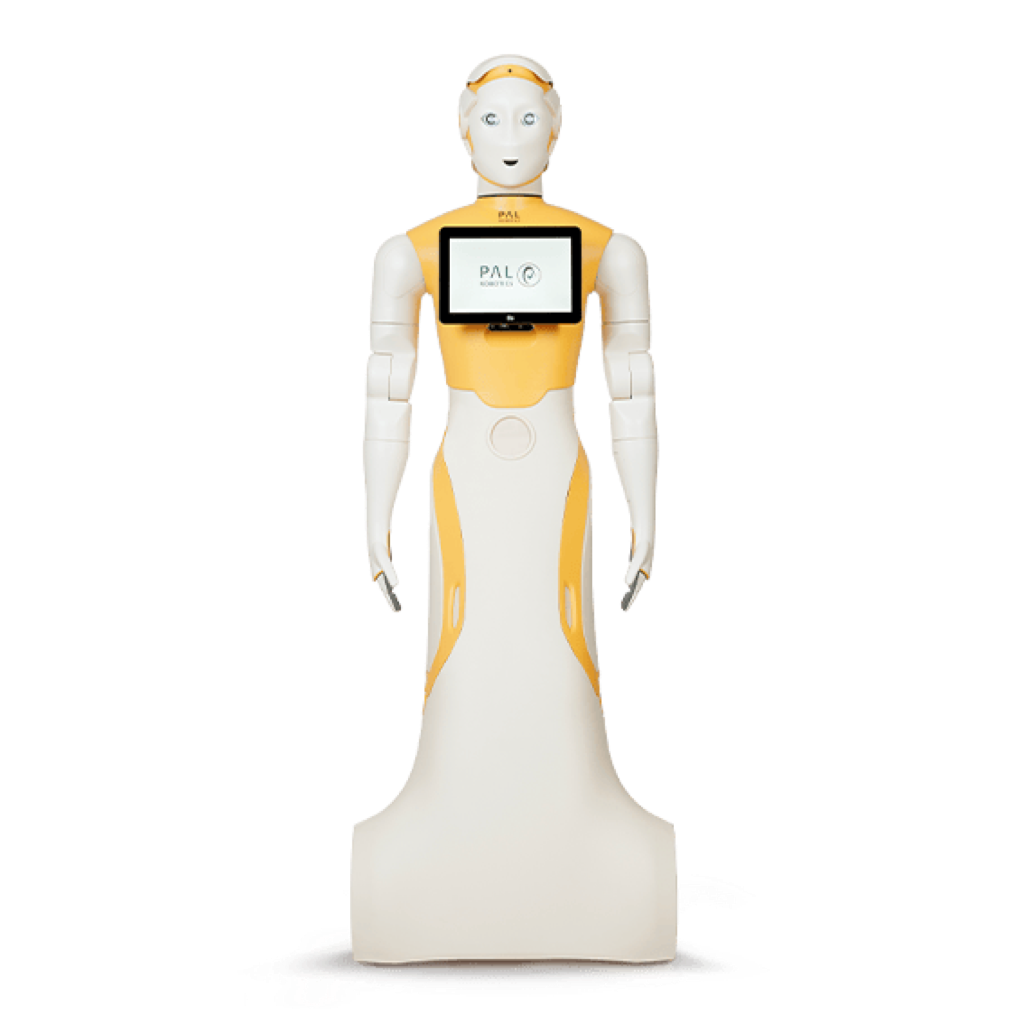
The PAL Robotics ARI is a 165 cm wheeled social humanoid designed for public spaces — hospitals, airports, retail and research labs — where it handles conversation, wayfinding and information. Unlike many flashy humanoids, ARI is a real, buyable product from an established Spanish robotics company. Pricing isn't published as a fixed USD MSRP, but distributor estimates put it roughly in the $35k–$90k range depending on configuration.
US buyers: ARI is Spanish-built, which the July 2026 rule reaches on its wording — confirm authorization before ordering.
PAL Robotics has long sold research platforms into US universities, and the country-neutral drafting of the FCC listing means a Barcelona-built robot is foreign-produced. We could not confirm whether ARI holds a pre-28-July authorization. Machines already in US labs are unaffected. For a new order, the FCC ID is the question to put to PAL in writing.
EU and UK sales continue normally under CE and UKCA marking; PAL's home market is unaffected.
As of 2026-08-30 · medium confidence — verify before you commit funds
What is the PAL Robotics ARI Robot?
ARI is the social PAL Robotics robot — built to talk to people at a desk, not to lift boxes.
Not every humanoid is trying to weld car parts or do your dishes. Some are built to talk to people, and ARI from PAL Robotics is one of the best-known examples. It's a social robot: a friendly face for a hospital lobby, an airport help desk, a retail floor or a research lab studying human-robot interaction.
PAL Robotics is a Barcelona-based company that's been building humanoid and service robots for years, which matters here. ARI isn't a concept teased on a stage — it's a shipping platform with a datasheet, a manual, and customers. That maturity is a big part of its appeal.
ARI leans into expression rather than raw strength. Animated eyes, LED lighting, gestures, a touchscreen chest and speech in more than 30 languages make it good at engagement and information, less so at heavy lifting. If you understand what it's for, it's a genuinely useful machine.
What is the PAL Robotics ARI?
ARI is a wheeled social and collaborative humanoid built for advanced human-robot interaction. It stands 165 cm tall with a fairly light 60 kg frame, and it's designed to look approachable — animated LCD eyes, expressive LED lighting, head and arm gestures, and a 10.1-inch touchscreen in the torso for menus, media and interfaces.
Its arms offer up to 5 degrees of freedom each and are made for gesturing and very light manipulation — around 0.5 kg payload per arm. This is not a robot for moving boxes; it's a robot for greeting, guiding and informing. That focus is the whole point.
Underneath, ARI runs on ROS (the datasheet references ROS Noetic), which makes it a favourite in research and university settings where teams want to build their own behaviours. It supports face recognition, skeleton tracking, speech synthesis and recognition, and 3D gaze estimation.
How does ARI move and navigate autonomously?
ARI gets around on a differential-drive wheeled base, reaching up to about 1.5 m/s on flat indoor floors. Wheels suit its job perfectly — public buildings are flat, and stability plus battery efficiency beat the drama of legs for a lobby robot.
For autonomy it uses Visual SLAM with RGBD cameras and optional LIDAR, so it can map an environment, localise itself and avoid obstacles while it moves. That means genuine autonomous navigation around a hospital corridor or airport concourse, not a robot on rails.
Endurance is decent for a service shift. The standard 40 Ah battery is rated for around 8 hours of autonomy and charges in roughly 5 hours, while a larger 60 Ah pack pushes that to about 12 hours (with an 8-hour charge). For an all-day greeter, thats a workable duty cycle.
How much does the PAL Robotics ARI cost?
PAL Robotics doesn't publish a single fixed USD sticker price for ARI, so be a little careful with any exact number you see. Pricing is quoted per configuration and per region, typically through PAL directly or EU distributors.
Based on distributor listings, ARI generally lands in the rough range of $35,000 to $90,000, depending on options like the larger battery, LIDAR, extra perception packs and support. Higher-end research configurations sit toward the top of that band.
Because it's sold business-to-business, expect quotes rather than a checkout button, and factor in support, software and maintenance. This is an institutional purchase — for a hospital, airport, retailer or lab — not a consumer gadget.
Can you buy ARI now, and who is it for?
Yes — this is one of ARI's real strengths. It's available to buy now as a commercial product, and PAL continues to update it; the company showed upgraded ARI units with enhanced AI perception and navigation at CES 2026.
The natural buyers are organisations that need a friendly, autonomous presence in a public space: hospitals and clinics (reception, wayfinding, patient info), airports (directions, multilingual help), retail (product info, engagement), and universities or research labs studying interaction and social robotics.
Who shouldn't buy it? Anyone needing heavy manipulation or a home helper. ARI's payload is tiny and its skill set is social. Match it to the mission — engagement and information — and it delivers; ask it to lift and carry and you've bought the wrong robot.
PAL Robotics ARI vs other social robots: is it worth it?
Compared with consumer-style social robots or one-off greeter bots, ARI's edge is that it's a full humanoid platform with mature software, ROS support and multilingual speech from an established maker. For research teams especially, the openness and documentation are a real advantage over closed appliances.
Against PAL's own lineup and rivals, ARI sits in the social/service niche rather than the industrial one — think of it as a cousin to reception and hospitality robots, not to warehouse humanoids. Its 30+ languages and expressive design make it strong for public-facing, multilingual environments.
Is it worth it? For the right institutional use case, yes: it's buyable today, autonomous in navigation, and backed by ongoing updates. The cost is real and the manipulation is minimal, so the value depends entirely on wanting a social robot — not a laborer.
The PAL Robotics ARI on video
Hands-on reviews and teardowns, picked for what they actually show rather than how loud the thumbnail is.
PAL's own overview of ARI as a social and research platform, not a labour robot
An actual unboxing from the manufacturer, which tells you what arrives in the crate
A full hour of hands-on ROS development on ARI — the practical view if you would be programming it
Who the PAL Robotics ARI is — and isn't — for
+Where it shines
- You can actually buy or reserve it as an individual, at a consumer price.
- Stated real-world payload (~0.5 kg per arm).
!Watch-outs
- Public data is thin; verify key figures before relying on them.
How the PAL Robotics ARI stacks up
Side by side with similar robots — the one you're reading about is highlighted.
| This robot PAL Robotics PAL Robotics ARI | PNDbotics PNDbotics Adam |  NEURA Robotics NEURA Robotics 4NE-1 |  NEURA Robotics NEURA MiPA | |
|---|---|---|---|---|
| Price (US) | $35,000 – $90,000 | $99,999 – $145,000 | $65,000 – $105,000 | ~$10,800 |
| Availability | On the market | On the market | Reservations open | Reservations open |
| Height | 1.65 m | 1.67 m | 180 cm | Unknown |
| Payload | ~0.5 kg per arm | ~5 kg | Arms rated ~20 kg; up to 100 kg lifting in leg-supported/full-body configurations | 5 kg per arm; ~15 kg deadlift |
| DoF | ~12 | Lite | Hands | Unknown |
| Buyer | Individuals | Enterprise | Enterprise | Individuals |
| Made in | Other | Other | Other | Other |
What the PAL Robotics ARI costs — and how to get one
PAL ARI ~$35k-$90k; social service humanoid.
Unknown
Leasing / RaaS: unknown
Every spec, grouped & sourced
Tap a group to expand. Values are labelled official vs third-party; unknowns are omitted, not guessed.
Body & movement▾
Power & endurance▾
Hands & senses▾
Brains & control▾
Claims vs evidence
Social AI; ROS
Where it's working
No verified large-scale deployment
Intended use cases: Social humanoid for hospitals, airports, retail: conversation, wayfinding
Should you consider the PAL Robotics ARI?
ARI is one of the more grown-up options in this space: a genuinely buyable, autonomously navigating social humanoid from an established maker, ideal for hospitals, airports, retail and research. Just remember it's built to greet and inform, not lift — and pricing is quote-based, roughly $35k–$90k, so scope it to your use case.
Score reflects stated criteria (availability, data confidence, US relevance) — not hands-on testing or user ratings. We're an independent review & comparison site; we don't sell robots. *Financing figure is illustrative.
How we know this
Data confidence 46/100 · last verified 2026-06-30. Specs are labelled official vs third-party and dated; unknowns are omitted, not guessed.
PAL Robotics ARI — your questions, answered in full
How much does the PAL Robotics ARI cost?+
There's no single published USD MSRP. Based on distributor listings, ARI roughly ranges from about $35,000 to $90,000 depending on configuration and options like the larger battery, LIDAR and perception packs. It's sold B2B, so you'll get a quote.
Can you buy the PAL Robotics ARI?+
Yes. ARI is a commercially available product aimed at businesses, hospitals, airports, retailers and research labs — not a prototype. PAL even showed upgraded versions at CES 2026.
What is ARI used for?+
Social and service roles in public spaces: conversation, wayfinding and directions, information display, greeting and engagement, plus human-robot interaction research. It speaks 30+ languages.
Does ARI walk or use wheels?+
It uses a wheeled differential-drive base, not legs, moving up to about 1.5 m/s indoors. It's 165 cm tall and weighs around 60 kg.
How long does ARI's battery last?+
The standard 40 Ah battery gives about 8 hours of autonomy and charges in roughly 5 hours. An optional 60 Ah pack extends that to around 12 hours with an 8-hour charge.
Can ARI lift or carry things?+
Only very light items. Each arm has up to 5 degrees of freedom with about 0.5 kg payload, meant for gestures and light manipulation — not heavy lifting or carrying loads.
Is ARI autonomous?+
For navigation, yes. It uses Visual SLAM with RGBD cameras and optional LIDAR to map, localise and avoid obstacles, so it moves autonomously around indoor spaces.
Who makes ARI?+
PAL Robotics, a Barcelona-based company with a long track record in humanoid and service robots. ARI runs on ROS, which makes it popular for research.
Peer-reviewed research on the PAL Robotics ARI
Published academic work — peer-reviewed papers and preprints — involving this robot or its maker's systems, indexed in scholarly databases (OpenAlex, arXiv). Not blog posts or press write-ups.
- ARI: the Social Assistive Robot and CompanionSara Cooper, Alessandro Di Fava, Carlos Vivas, Luca Marchionni, Francesco Ferro · 2020 · 2020 29th IEEE International Conference on Robot and Human Interactive Communication (RO-MAN) · DOI 10.1109/RO-MAN47096.2020.9223470
- Lessons Learnt from Deploying ARI in Residential CareSara Cooper, Francesco Ferro · 2022 · TRAITS Workshop, ACM/IEEE International Conference on Human-Robot Interaction (HRI 2022); arXiv preprint
Academic references are factual citations from open scholarly indexes; listing is not endorsement.